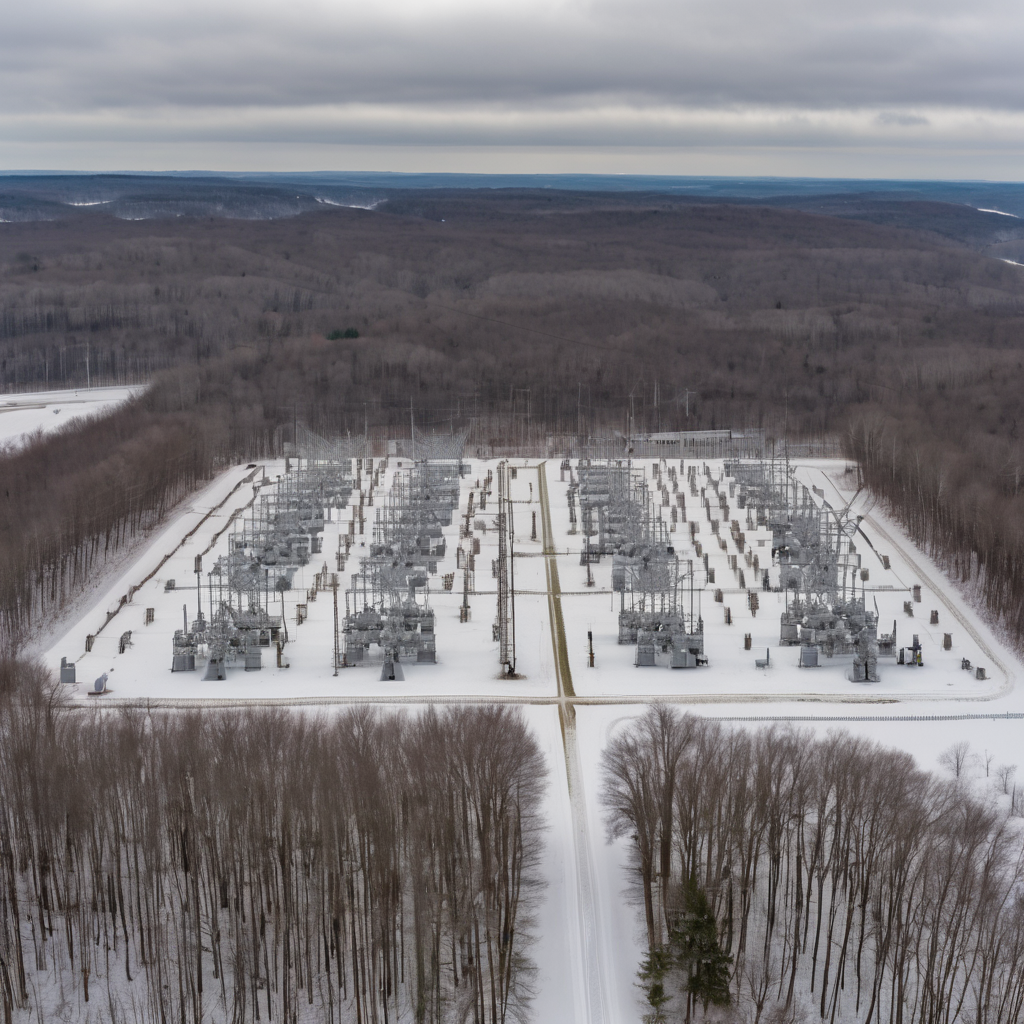
A new five year capital plan the size of the Interstate Highway System is reshaping American energy, and opening one of the biggest job markets of the decade.
Something happened this month that ought to reframe how Americans think about their power bill, and about their paycheck.
A new study from the research nonprofit PowerLines found that 51 investor-owned utilities are now planning to spend at least $1.4 trillion on capital projects through 2030. That is a more than 27 percent jump from the $1.1 trillion they projected just one year ago. It is also one of the largest coordinated investment cycles any U.S. industry has announced in a generation.
To put that number in perspective, Fortune called it a $1.4 trillion "spending spree" driven by AI and the data center build out. Latitude Media described the spend as the equivalent of "thousands of Hoover Dams." CBS News framed it as the single biggest grid build out in modern American history.
Think of the last time the United States attempted something at this scale. The Interstate Highway System. Rural electrification. The broadband rollout. What America is about to build between now and 2030 is of that order, and it is happening on top of a grid most of us never think about until the lights flicker.
Whatever you call it, the shape is the same. This is the beginning of a new growth economy. And it will not build itself.
Where the $1.4 Trillion Actually Goes
PowerLines' analysis splits the spending into two big buckets. Nearly half goes to transmission and distribution. That is the poles, wires, substations, and switching equipment that carry electricity from where it is made to where it is used. About 30 percent goes to new generation, including natural gas, nuclear, solar, wind, and storage.
That split tells you the story in one line. The grid itself, the wires more than the power plants, is the bottleneck, and utilities know it.
The drivers will be familiar to anyone who has been reading Positive Current over the last few weeks.
- AI and data centers. Hyperscale computing is now the single biggest new load on the system. As we reported in Schneider Electric Rides Data Center Boom Into 2026, executives say their orders for data center power gear are booked 18 to 24 months out.
- Reindustrialization. Chip fabs, EV plants, and advanced manufacturing facilities are landing in places that, ten years ago, were forecasting flat demand.
- Electrification. Homes are swapping gas furnaces for heat pumps. Drivers are trading gasoline for kilowatt hours. Our reporting on the EV shopping surge showed that transition running faster than the infrastructure planned for it.
- Extreme weather and wildfires. Hardening is no longer optional. It is a line item, as we covered in California's Wildfire Crisis Drives Utility Bills 20% Higher.
- Renewables crossing over. This spring, renewables outgenerated natural gas for a full month for the first time in U.S. history. Every new solar farm, battery site, and transmission line built to carry that power is part of the $1.4 trillion.
- Aging iron. A meaningful share of the U.S. grid is running on equipment older than the engineers maintaining it.
Why This Is a Growth Story, Not Just a Bill Story
It would be easy, and partly fair, to read $1.4 trillion as a rate headline. PowerLines projects that residential customers could ultimately bear close to half of the total, roughly $700 billion, on top of bills that are already up about 40 percent since 2021.
Affordability matters, and Positive Current has been clear eyed about it. Our earlier explainer on why energy bills keep rising laid out the structural reasons. Infrastructure that used to be partly financed through federal programs is now flowing through household statements instead.
But a capital expenditure is, by definition, an investment. Every mile of new transmission, every substation, every combined cycle plant, and every solar farm is a job site, a payroll, a tax base, and a supply chain.
Consider one data point from our own reporting. When Texas regulators approved two new Entergy gas plants for southeast Texas with a $2.4 billion hard cost cap, the state estimated 9,000 construction jobs and about $2.8 billion in regional economic activity from those two facilities alone.
Multiply that kind of build across the country, across the decade, and the picture changes. The grid stops being a cost center and starts looking like the country's next major industrial platform, the thing new factories, data campuses, and towns plug into before they can grow. States like Virginia and Indiana have already begun treating interconnection itself as a transferable asset, turning grid access into infrastructure policy.
That is what a growth economy looks like. Unglamorous, regulated, infrastructural, and already here.
The Catch: You Can't Pour $1.4 Trillion Into Steel Without People
Money is no longer the binding constraint. People are.
Goldman Sachs estimates that the U.S. power industry will need more than 750,000 new workers by 2030 to deliver the build out already on the books.
The Center for Energy Workforce Development, a coalition of more than 140 energy employers, unions, schools, and associations, has flagged the same squeeze from the other direction. CEWD's biennial workforce survey finds the sector needs roughly 207,000 additional transmission and distribution workers by 2030, and closer to 386,000 once expected retirements are factored in. To get there, U.S. energy apprenticeships would need to step up from about 45,000 active slots a year to roughly 65,000.
The U.S. Department of Labor sizes the retirement wave starkly. Nearly half of today's power sector workforce is expected to retire within the next decade. These are the lineworkers who restore service after ice storms, the relay technicians who keep substations calibrated, the control room operators who balance load in real time, and the planners who design the interconnections everything else depends on.
Positive Current has been covering these careers one at a time, because the jobs behind the grid deserve the same visibility as the jobs at a tech company. Our profile of relay technicians showed a career path into one of the most essential and respected roles in power, with senior techs and protection and control engineers earning $100,000 to $130,000 or more, often without a four year degree.
That is the workforce angle that too often disappears inside a capital expenditure headline. The $1.4 trillion isn't just a line on a utility's earnings call. It's a help wanted sign the size of the country.
What This Means for Your Community
A growth economy built around the grid has a wider base of beneficiaries than most sectors. Here is what it looks like at the ground level.
- For workers and students. Line schools, trades programs, community colleges, and engineering pipelines become front door institutions for a durable middle class career, one that exists in every region, not just in coastal tech hubs.
- For communities. Every substation and generating station anchors local payrolls, property taxes, and small business demand. Southeast Texas, south Louisiana, the Ohio Valley, the Southeast, and the desert Southwest are all build zones now.
- For manufacturers. Transformers, switchgear, conductor, concrete, steel, software. The domestic supply chain that serves the grid is in the early innings of its own reindustrialization.
- For utilities and investors. A clear, multi year capital runway is rare. This one exists because demand is undeniable.
- For customers. Long term, the best rate story is a grid that can actually serve the economy. Reliable service, fewer outages, and enough capacity that new jobs can plug in.
What It Will Take to Get This Right
A $1.4 trillion capital plan is not automatic. The same PowerLines report that named the number also warned that construction inflation, tariffs on electrical equipment, and interconnection backlogs are all putting real pressure on timelines and costs. Positive Current has covered each of those dynamics, from surging project costs after new tariffs hit, to gas plants that cannot be built fast enough to stop reliability gaps.
So what does it take to actually convert this capital into a growth economy, rather than a rate shock?
- Regulators who move with discipline. Approve prudent projects on reasonable timelines, and apply cost caps when the public interest demands them. That is the kind of discipline Texas used on the $2.4 billion Entergy approval.
- States that treat interconnection as policy. Virginia and Indiana are showing what happens when grid access is treated as infrastructure, not paperwork.
- A workforce strategy that matches the capital strategy. Apprenticeships, pre apprenticeships, transition programs for veterans and oil and gas workers, and a steady drumbeat of career visibility so young people know these jobs exist.
- A durable affordability frame. Customers shouldn't have to choose between reliability and a manageable bill. The conversation about investment and the conversation about affordability have to happen in the same room.
The Bottom Line
The United States is not just modernizing its grid. It is standing up a new growth economy on top of it, one measured in trillions of dollars, hundreds of thousands of jobs, and decades of infrastructure that will outlast every political cycle in between.
The $1.4 trillion number will generate plenty of headlines. The more important number, at Positive Current, is the one behind it. The people who will turn that capital into a working grid. Roughly 750,000 new hires by 2030, and counting.
That is the story we'll keep telling.