


The jobs number arrived before the construction schedule did, which almost never happens on a nuclear project.
What happened
On October 19, Sonal C. Patel reported in POWER that American Electric Power and X-energy signed a joint development agreement to study a 960 megawatt advanced nuclear plant at the retired Breed Generating Station in Sullivan County, Indiana. Robert Walton covered the same agreement for Utility Dive that day, and World Nuclear News attached the figure that makes this a workforce story: roughly 1,000 construction jobs and about 100 permanent jobs if the project gets built.
The site belongs to Indiana Michigan Power, the AEP operating company serving northern Indiana and southwestern Michigan. Breed was a coal station. It comes with transmission ties, water access, and a county that already knows what a generating plant is and what it pays. That is the short version of why developers keep going back to retired coal sites instead of starting on open ground.
The design is X-energy's Xe-100, a pebble bed reactor that runs hot and uses helium rather than water to carry heat out of the core. Each unit is rated at 80 megawatts of electricity and 200 megawatts of thermal output. The plan calls for 12 of them, arranged in three groups of four, so each group produces 320 megawatts. Amazon is funding the development work and intends to buy the power under a long term contract if the plant reaches commercial operation, a point Tom Zimmerman spelled out at WZDM in Vincennes on October 20.
No final investment decision has been made. That caveat shapes how to read every number below, and the companies have said so plainly.
Why it counts
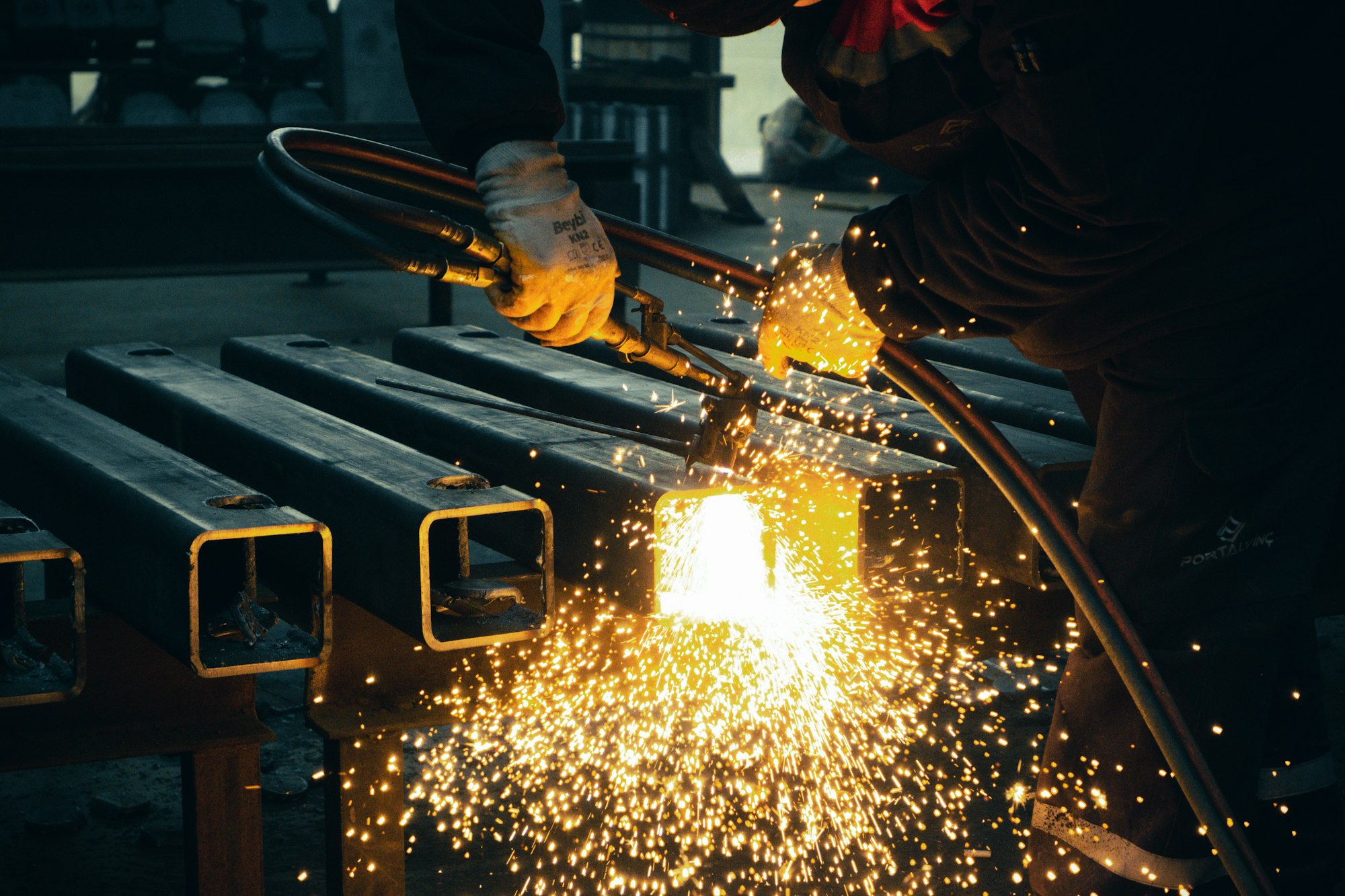
A thousand construction jobs is a real number for a county this size, and it is the kind of number that shows up in a hiring hall before it shows up in a press release. Heavy civil work comes first: earthmoving, foundations, rebar, concrete. Then the mechanical trades, pipefitters and millwrights and ironworkers, followed by electricians and instrumentation techs as the units get dressed out. On a twelve unit build arranged in groups, that sequence repeats, which is what crews actually want. Repetition is how a craft worker goes from learning a job to being fast at it, and it is how a contractor justifies keeping a crew together between phases instead of laying it off and rehiring.
The 100 permanent jobs are a different animal. Nuclear operations is a licensed trade with a long on ramp: reactor operators, radiation protection techs, chemistry, security, maintenance planners. AEP is not starting that bench from zero. Indiana Michigan Power already operates the 2,278 megawatt Donald C. Cook Nuclear Plant in Michigan, and X-energy chief executive J. Clay Sell framed the agreement as one that pairs AEP's "50 years of excellence in nuclear operations" with Amazon. The operating experience is real, and it is in house.
Then there is the part of the workforce that never sets foot in Indiana. The Xe-100 runs on TRISO fuel, uranium kernels wrapped in layers of carbon and ceramic, made from high assay low enriched uranium. X-energy's subsidiary TRISO-X makes it, and in July the Tennessee Department of Economic and Community Development announced that the company would add 1,140 jobs at a fuel facility and research center at Horizon Center Industrial Park in Oak Ridge. TRISO-X holds a 40 year Nuclear Regulatory Commission license to build and operate that commercial scale plant. A reactor order in Indiana is a production order in Tennessee.
The numbers
960 megawatts under study. Twelve Xe-100 units at 80 megawatts each, in three groups of four at 320 megawatts per group. Roughly 1,000 construction jobs and about 100 permanent jobs, per World Nuclear News, contingent on the project advancing. A 40 year NRC license already in hand for the Oak Ridge fuel plant, and 1,140 jobs announced there in July.
Zoom out and the Indiana study sits inside a larger program. This is the second project under a 2024 collaboration between Amazon and X-energy aimed at more than 5 gigawatts of new United States nuclear capacity by 2039. The first is Energy Northwest's Cascade project in Washington state, also sized at 960 megawatts. The first Xe-100 deployment is planned at Dow's Seadrift site in Texas, where the reactors would serve an industrial customer rather than a utility grid.
AEP's own buildout is the backdrop. The company reported a $78 billion capital plan covering 2026 to 2030 and has roughly 33,000 megawatts of owned and contracted generating capacity. It reports third quarter results and its 2027 to 2031 capital plan on October 28, which is the next real checkpoint for anyone trying to size AEP's hiring over the back half of the decade.
What comes next
The feasibility study is the immediate work, and it is not clerical. It covers site characterization, water, transmission interconnection, and the licensing path through the NRC. None of that produces a construction job this year.
What does produce something this year is the pipeline work. Sullivan County recently joined Indiana's Advanced Nuclear Ready Communities Program, run by the state Office of Energy Development, which sorts communities into three tiers: Nuclear Aware, Nuclear Prepared, and Nuclear Ready. Paul Ciampoli reported for the American Public Power Association in July that designation turns on community education, site characteristics, community support, regulatory readiness, and workforce and education readiness, with an explicit goal of building local pipelines through partnerships with schools and colleges to "prepare local talent for high tech energy careers."

That last criterion is the one worth watching. A county that lines up a welding program, an instrumentation certificate, and a construction craft pre apprenticeship now has graduates ready when a final investment decision lands. A county that waits buses its work in. The difference is a curriculum decision made two or three years early, and it is made by community colleges and career centers, not by the developer.
The other decisions sit where they always sit. The NRC licenses the design and the site. The Indiana Utility Regulatory Commission and the state legislature set the terms a utility can build under. AEP's board makes the investment call. The announcement in October was a study agreement, not a groundbreaking, and nobody involved pretended otherwise.
The Bottom Line
A retired coal site in southwestern Indiana is being studied for 12 small reactors, and the workforce arithmetic is unusually legible for this stage: about 1,000 building it, about 100 running it, 1,140 already committed in Tennessee to make its fuel. None of it is guaranteed, and the construction crews are years out. But the training decisions that determine who gets those jobs are being made right now, by people in Sullivan County and the schools around it, and those decisions do not wait for a final investment decision.
Sources: Sonal C. Patel, POWER | Robert Walton, Utility Dive | World Nuclear News | Tom Zimmerman, WZDM | AEP news release | Tennessee Department of Economic and Community Development | Paul Ciampoli, American Public Power Association | Indiana Office of Energy Development


